You’ve probably tried to declutter before. You picked a day, you told yourself you would finally get things in order, and you started cleaning.
You may have filled a few bags, and you might have even felt proud for a moment.
But when a few days or weeks passed, you could see everything slowly slipping back. The mess came back, and you could feel even more frustrated because you had already tried.
So now you might be thinking what are you doing wrong?
The truth is, decluttering isn’t failing because you’re lazy. You might think you should try harder, but that’s not really the problem.
When you start decluttering without knowing it, you can make a few small mistakes. And when you make those mistakes, they can quietly undo everything you worked for.
In this article, you’ll see those mistakes clearly. When you understand them, you can fix them. And when you fix them, you can finally make your decluttering last this time.
Are You Trying to Declutter Everything at Once?
You start with good energy, and you’re thinking, “you will fix this whole mess today.”
So you move from your room to your closet, and you might go to a drawer, and then you may even jump into the kitchen.
But after a while, you can feel it, you are getting tired, you are getting confused, and you are surrounded by even more mess than before. So you stop.
This is where you usually go wrong.
When you try to do everything at once, your brain can get overloaded. You are making too many decisions at the same time, and you can feel it draining you fast.
Every item that you pick is asking you, you will keep it or you will let it go and you might not realize how quickly that can exhaust you.
That’s why you lose your momentum and you end up quitting halfway.
Instead, you should keep it simple. If you start with just one small area, you can actually handle it better.
You might choose a single drawer, or you could pick one shelf, or you may just focus on one corner.
When you finish that one space properly, you will see real progress, and you will feel it too. And if you feel that small win, you will find it much easier to continue the next day.
Do You Even Know Why You’re Decluttering?
Most people start decluttering without a clear reason. You just look at your space, you feel stressed by the mess, and you decide you will start cleaning things out.
But you don’t really have a goal in your mind, you are just reacting to how your room or your space looks at that moment.
And that’s exactly why it doesn’t last for you.
When you don’t know why you are decluttering, every decision can feel random for you.
You pick up an item, and you might think, “you could keep this or you could throw it or maybe you’ll need it later.”
So you end up keeping most things, because you don’t want to feel like you made a wrong choice.
But when you have a clear reason, you can feel everything change.
If you tell yourself, “you want a calm room where you can think clearly,” or “you want less stuff so you can clean easily,” then your decisions will start becoming easier for you.
You will stop getting stuck emotionally on every item, and you will start asking if it actually supports your goal or not.
Without a reason, you can feel like decluttering turns into confusion. But when you have a reason, you can feel like it turns into direction for you.
Are You Keeping Things “Just in Case”?
This is one of the biggest reasons clutter keeps coming back for you.
You pick something up, and instead of deciding based on your real life, you start thinking, “you might need this later.” So you keep it.
Then you do the same thing with another item, and then another.
Slowly, you can see how your space starts filling up with things you don’t actually use, but you still keep holding onto them.
The problem is, “just in case” is not a real plan for you. It might feel safe, but it is actually a fear-based decision.
You are not keeping the item because you need it right now, you are keeping it because you don’t want to feel regret later.
But if you look at reality, most of these “just in case” things never get used by you.
And even if you do need something someday, you will often end up buying a better or newer version anyway, so you can see how the old one was just taking space for no reason.
A better way for you to decide is to ask yourself: have you used this in the last 6-12 months?
If you haven’t used it, and it’s not something essential or hard for you to replace, then you probably don’t need to keep it.
Are You Starting with Items That Are Hard to Let Go?
A lot of people start decluttering by going straight into the hardest things, you know, old photos, gifts, memories, or even expensive items that you never really used.
You might think you are “getting the difficult part out of the way,” but for you, it usually does the opposite.
You slow down immediately. Every item pulls you in different directions, you start thinking, you start remembering, and you might even overanalyze everything.
Instead of making real progress, you get stuck in emotions and decisions that can drain your energy very fast.
When you begin with emotional items, your brain gets tired early.
And once you are mentally exhausted, even simple decisions like “you should throw this old charger away” can suddenly feel difficult for you.
That’s when you stop, you leave things halfway, and you feel like nothing really changes.
But if you take a better approach, you can make it much easier for yourself.
You should start small and neutral. If you begin with items that don’t carry emotional weight for you like duplicates, broken things, or random unused stuff, you can build momentum step by step.
And when you do that, you will feel decision-making becoming easier for you. Once you gain that confidence, you can slowly move toward the harder categories without feeling overwhelmed.
Are You Overthinking Every Small Decision?
You pick up an item, and for you it suddenly turns into a long mental debate.
You start thinking, “you might need this later,” and then you tell yourself, “but you spent money on it,” and then another thought comes in, “you could use it someday.”
And just like that, a simple decision becomes heavy and tiring for you.
This is one of the biggest reasons your decluttering slows down or even stops.
You are not just sorting things, you are analyzing every single object like it has some hidden future value for you.
And when you keep doing that, you can feel how fast your energy gets drained.
The real issue is not the items for you. The real issue is the pressure you put on every decision.
When everything feels important to you, nothing feels easy to let go of. So instead of clearing your space, you end up just moving things around without seeing real progress.
But you can make it easier for yourself. If you reduce the pressure on each choice, everything starts to change.
You don’t need a perfect reason for every item. You can keep it simple: if you use it, you keep it.
If you don’t use it and it doesn’t add real value to your life right now, you let it go.
And when you start deciding faster, you will notice how the whole process becomes easier for you.
Are You Cleaning and Organizing Instead of Decluttering?
This is a mistake most people don’t even notice for you.
You start with the intention to declutter, but somewhere along the way you end up cleaning, folding, sorting, and organizing instead.
For you, the space starts to look better, so you feel like you’ve made progress, but nothing has actually left your house.
And that’s the real problem for you. You are improving how things look, not reducing how many things you actually have.
Cleaning and organizing can make your space feel fresh for a short time for you, but the clutter is still there. It is just arranged neatly.
So after a few days, you can see the same problem coming back again, because the root issue was never solved for you.
Real decluttering is about making decisions for you, mwhat you will keep and what you will let go.
If you skip that part and only focus on arranging things, you are basically just reshuffling your clutter, not removing it from your life.
But you can fix it in a simple way. If you separate the two tasks, it becomes much easier for you.
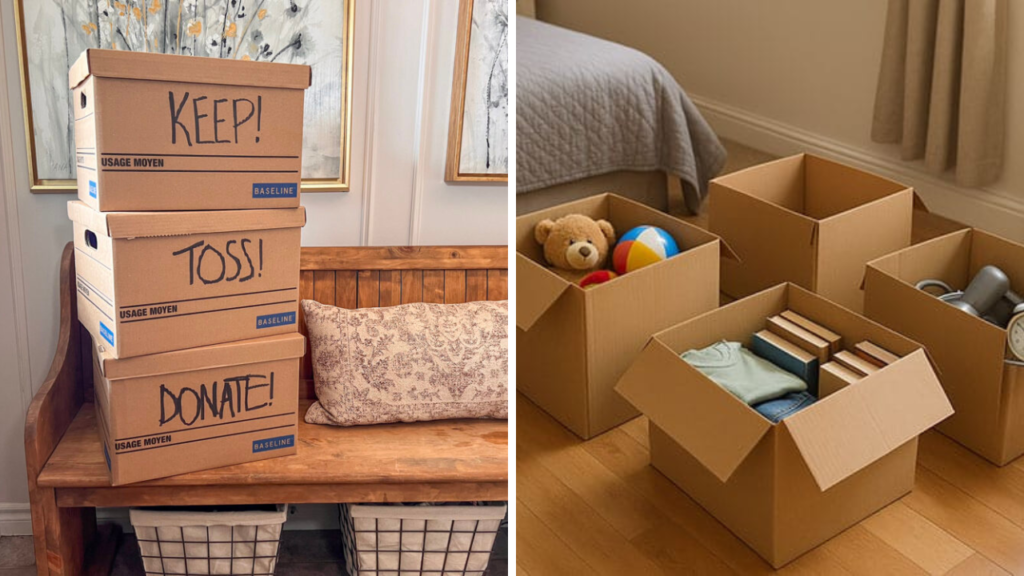
First, you should declutter without organizing. You only focus on removing what you don’t need.
And once that part is done, then you can think about putting things in order so your space finally stays clear for you.
Do You Give Everything a Proper Place?
A lot of your clutter problems don’t actually start because you have too much stuff. They start because you don’t really know where things belong.
You use something, you put it down somewhere “for now,” and you don’t give it a real home.
Later, when you need it again, you can’t find it, or you see it sitting in some random corner.
And slowly, without you even noticing, things start spreading across your space and you lose control over where everything is.
When items don’t have a proper place, your home can become messy again very easily, even if you just cleaned it.
You keep moving things from one spot to another instead of returning them where they actually belong.
That’s why decluttering alone doesn’t fully solve the problem for you.
If every item doesn’t have a clear, fixed spot in your space, clutter will keep coming back no matter what you do.
But you can fix this in a very simple way for yourself. After you decide what you want to keep, you should immediately decide where it lives.
Not “somewhere in this room,” but one specific place for each item. And every time you use it, you should return it back to that exact spot.
If you build this one habit, you can stop most of the mess from building up again.
What are You Bringing in New Stuff Faster Than You Remove It?
This is one of the most common reasons clutter keeps coming back for you, even after you do a big declutter.
You clean your space, you feel good about it, and then slowly you start adding new things again, clothes, small gadgets, home items, packages, gifts.
At first, it doesn’t feel like much for you. But over time, you can see how new items quietly start replacing the space you just cleared.
So even if you decluttered properly, your progress can slowly get cancelled out for you.
The real issue is not just clutter, it’s the balance between what comes in and what goes out of your space.
If you keep adding things without checking what you already have, your space will always stay full, no matter how many times you clean it.
Most people don’t track this for themselves. They only focus on removing items once in a while, but they don’t really control what enters their home every day or every week.
That’s why you can feel like the same cycle keeps repeating again and again.
But you can fix it in a very simple way for yourself. Every time you bring something new in, you should make sure something else goes out.
It doesn’t need to be big or complicated. Even one item out for one item in can slowly help you keep your space under control and stop clutter from building up again.
Do You Feel Guilty Throwing Things Away?
This is a quiet but powerful reason clutter stays in your home for you.
You pick something up, and you immediately start thinking about the money you spent on it, or who gave it to you, or the memories attached to it.
And then a feeling comes in for you, “you feel like it’s a waste to throw this away.” So you keep it, even if you don’t use it at all.
Over time, this guilt can slowly build up and start controlling your decisions.
You stop asking yourself whether you actually need something, and you start asking whether it feels “wrong” for you to let it go. And that shift is exactly what keeps your space full.
But the truth for you is simple: keeping something you don’t use is not bringing back your money, and it is not really preserving the moment either.
The item stays in your space, but the value you are holding onto doesn’t change your present life.
A better way for you to think about it is this: the money is already spent, and the memory will still stay with you even if the object is gone.
If something is not useful in your life right now, then keeping it just because of guilt only adds more stress and heaviness to your space.
Do You Expect One Decluttering Session to Fix Everything?
A lot of people treat decluttering like a one-time project for you.
You pick a day, you do a big cleanout, you feel that relief for a moment and you start thinking the problem is gone for good for you.
But then, a few weeks later, you can see the clutter slowly coming back again. And that’s exactly when frustration starts building up for you.
The mistake here is that you expect permanent change from just one effort.
Your home didn’t become cluttered in one day, so it cannot stay organized from just one decluttering session either for you.
Life keeps bringing new items into your space, and your habits are what decide whether things stay under control for you or slowly build up again.
When you expect one big declutter to solve everything for you, you naturally stop paying attention afterward.
You go back to the same old habits, and that’s when the cycle starts repeating for you again.
But the real fix is simple for you: you need to see decluttering as an ongoing process, not a one-time event.
If you do small regular resets and build simple habits, they will matter more than one intense cleaning day for you.
And if you accept that mindset, your space can stay lighter and more manageable for a much longer time.
Conclusion
If your decluttering never lasts for you, it’s not because you’re not trying hard enough.
It’s because the same small patterns keep repeating in your routine, doing too much at once, overthinking every decision, keeping things “just in case,” and expecting one big cleanup to fix everything for you.
When you look at all of these mistakes together, one thing becomes very clear for you: decluttering is less about removing stuff and more about changing how you make everyday decisions about your space.
You don’t need a perfect system or a full-day reset to fix it.
You need smaller, simpler choices done consistently for yourself, what comes in, what stays, and what actually has a place in your life right now.
If you fix these patterns in your daily habits, your space won’t just look better for a few days. It can actually stay manageable for you in the long run.

Hi, my name is Zeeshan, and I am the founder of The Crafts Geek. I have been passionate about DIY projects, home organization, and creative problem-solving for years. Over time, I realized that simple storage solutions and practical DIY ideas can make a huge difference in how a home looks and functions.